Making Small Talk BIGGER
And maybe it's not so small after all?

In this week’s Small Business Casual episode, I’m diving into the deep end and asking who, what, when, where, how, and why as it relates to the ever-dreaded small talk!
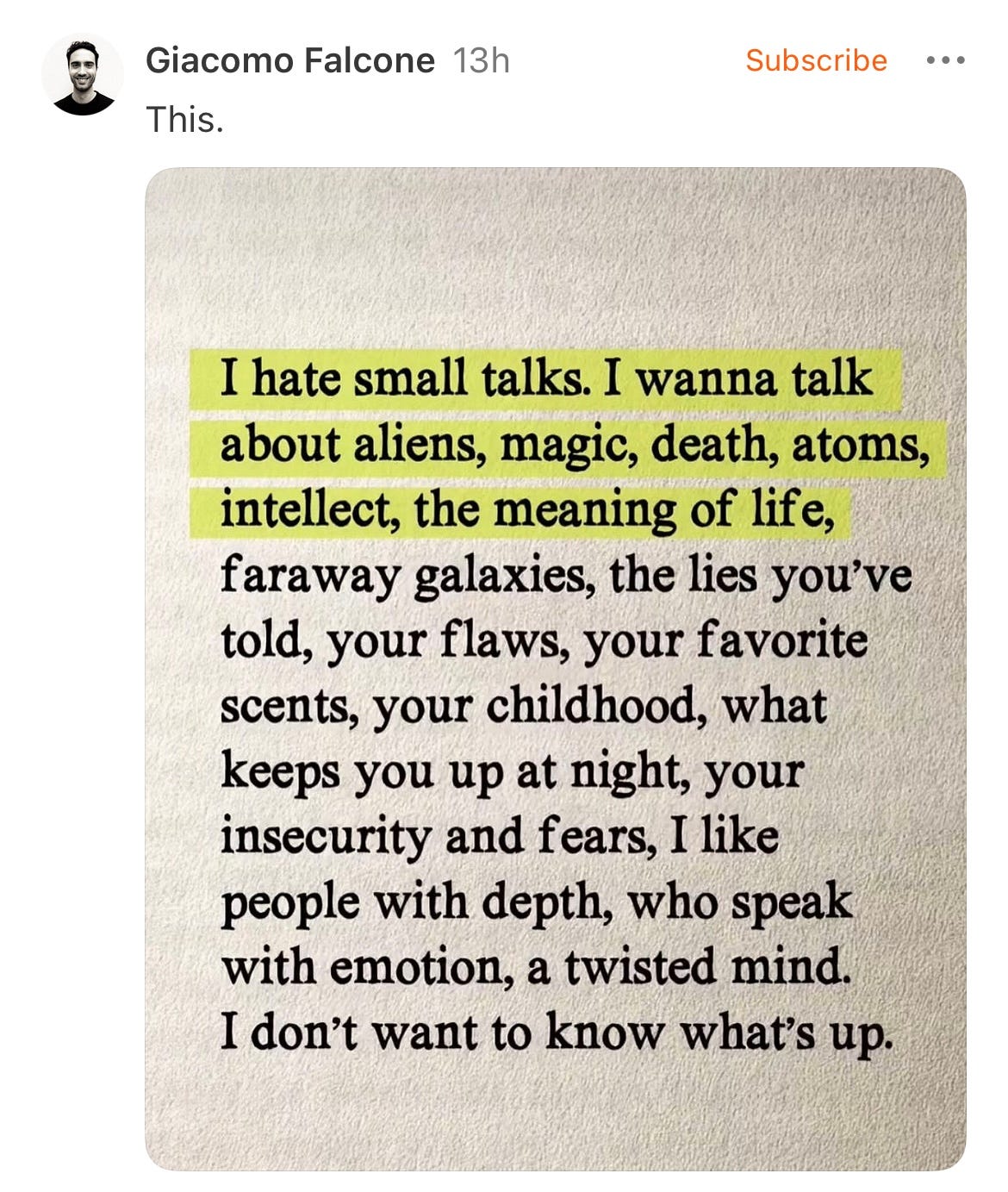
If you loathe swapping senseless words with cashiers and strangers…
If you go out of your way to avoid neighbors, coworkers, and folks you know at the grocery store lest you get stuck in idle chit-chat.
If you get heart palpitations just thinking about discussing the weather at a networking event…
Congratulations! You may have an aversion to small talk! And while I’m sure there’s some sort of legal recourse or compensation you’re entitled to, I’m not a lawyer and don’t know the steps to get it, but I do know…
This article and podcast episode are for YOU!
What actually IS small talk?
Small talk is defined by the Oxford English Dictionary as “Polite conversation about unimportant or uncontroversial matters, especially as engaged in on social occasions.”
However, it’s a rather broad, relative, and vague term. When people say “small talk,” they usually mean:
Light, casual conversation
A loop of unoriginal and formulaic questions (What do you do? How about all this rain?)
Talking about mundane topics simply to say SOMETHING
Conversing about something that simply doesn’t interest THEM
“Small talk is a ritualized and formulaic form of conversation, generally consisting of simple exchanges focused on a range of topics considered “safe” to talk about for people who might not know each other well. The content is typically either trivial or unimportant or based on common knowledge, offering plenty of opportunities for all people involved to participate safely.” -Padilla Cruz, 2005
Small talk might not exchange or transmit useful information, but…
Don’t discount it entirely!
The purpose of it is to establish a feeling of solidarity or connection (or at very least, acknowledgment) among the people involved.
Small Talk Gets a Bad Rap
Many even claim to despise it. Yet, it makes up nearly ⅓ of daily conversation, so maybe it’s not so small after all?
Reasons not to enjoy it:
It can feel like a waste of time -let’s get to the good stuff already! Enough with the surface-level!
It can make you feel stuck or trapped in a conversation
Social anxiety, introversion, neurodiversity, high empathy, and high sensitivity can all increase the discomfort of it
You might feel like you’re not “good” at it
It might feel dull
It can be draining
It can feel awkward (and we often overestimate how awkward it is/will become)
Do you enjoy small talk? If not, why?

What if we reframe small talk?
Frequent interactions with weak ties—like brief chats with baristas or neighbors—are associated with higher levels of well-being and life satisfaction. Psychology Today How Daily Small Talk Can Improve Well-Being
Experiments with London commuters who chatted with strangers on the train reported more enjoyment than those who remained silent. Source of study
A 15-day study of 151 office workers (published in the Academy of Management Journal) found that small talk, though sometimes distracting, led to healthier emotions, a greater sense of belonging, and more willingness to help colleagues.
Employees who had more small talk than average felt more positive emotions and enhanced well-being, and were more cooperative, even if it dented immediate productivity. “What’s so great about small talk?”
People who engaged in a brief pre-negotiation call (“small talk”) negotiated more cooperatively, shared more info, threatened less, and trusted each other more—than pairs who skipped it entirely. “What’s so great about small talk?”
Even a mere four minutes of small talk improves cooperation. -Psychology Today
Looks like small talk isn’t the archenemy after all!
In fact, it’s starting to feel like it might be a bit NECESSARY to get to the big stuff.
FIVE benefits of small talk for business owners and professionals:
It allows you to get a sense of others (and for them to get a sense of you): to see if there’s potential to go deeper. Small talk lets you get a read, tune into each other’s body language, take the pulse, get the vibe, you get the idea.
While anxiety-producing for some, remember that it can be calming for many (including your clients who might not be ready to dive right in with you!)
It can be bonding and open up to areas of common interest you hadn’t even considered!
It builds trust, cooperation, and is good for your mental health!
It helps people warm up to the big talk!
Ideas for making small talk BIGGER
Active listening and curiosity. People are interested in people who are interested in THEM and their lives. Practice curiosity everywhere you go! No awkward ice breakers necessary, “Wow, that’s really interesting, tell me more about what that looks like.” “What do you really feel about that?” Listen without just listening for your turn to talk. Open-ended questions that begin with who, what, where, why, when, how, will take you MILES.
Find the Spark Word. Listen for words that show you what they value or prioritize outside of work: “I had to drop my kids off at school before this event.” And bridge the statement with a follow-up question (with a little bit of self-disclosure for good measure), “Oh, how old are they? My oldest just started middle school, and I forgot how fast the years go!” Tiny sparks can become BIG conversations in no time!
Try an icebreaker: Some people love them, some people hate them. They can be really good in certain situations for sure. I always love when, in a group setting, it’s written down or given out ahead of time to put everyone (whether prepper or not) at ease.
Reframe it in your mind as a treasure hunt. Dive in, eager to discover what fascinating or juicy tidbit you might unearth. Who knows where the conversation might lead? Can you look for a compliment to give them, a unique detail you hear that others may overlook?
Remember, a conversation works both ways: Small talk is a very normal part of regular interaction with strangers and acquaintances and you don’t need to get STUCK lingering on a topic. If you’re talking about the weather and it’s going nowhere (fifteen minutes into the precipitation report later…), you can shift it naturally! “What’s your favorite thing to do when it rains this much?” or “What kinds of things have you been working on during these gorgeous summer days?”
Mini-itty-bitty small talk tips:
Embrace your sense of humor
Accept that lulls in conversation happen, don’t resist the discomfort, just know it’s normal!
Respond how you would want to be responded to. If you don’t enjoy receiving one-word answers or yes, no, don’t GIVE them.
Be genuine and use the strengths, all those fabulous strengths of your personality, your unique brain, and the power of YOU.
Resist the urge to only talk about yourself
Avoid rapid-fire questions or entering into interrogation mode. This can be off-putting or come off as prying.
Practice in low stakes. When you’re getting your coffee from Starbucks or online in a comment, when you’re passing your neighbor. Get more comfortable with it because it’s not nearly as awkward as we make it out to be!
Final Takeaway:
Next time you get stuck in small talk, remember why it matters so much. It’s a foundation, it opens doors, it’s a path forward to endless possibilities! Give yourself permission to practice these tips or some of the others I share in the resources, open your curiosity WIDE, and let’s start bridging from the light banter to the meaningful depth we crave together, shall we?
Great collaborations and the best of friendships often start with those seemingly “small” words that open big doors.
It’s not at all small when you look at it through that lens, is it?
Additional Resources:
Make Big Talk (Instagram Account) - thank you for sharing Amy Bolduc!